In this post (7 sections)
- brightonSEO 2026 was an AI search conference
- Nobody really knows how AI search works yet
- The AI citation tracking problem nobody wants to talk about
- The shiny new toys: automation and prompt libraries
- The fundamentals have not changed, and that is the actual story
- This feels a lot like 2010 SEO
- What I am taking back to client work
In short
- brightonSEO 2026 was dominated by AI search, yet Google still handles the vast majority of searches.
- ChatGPT draws mainly on Bing’s index, Claude on Brave’s and Gemini on Google’s, so ranking well in search still predicts being found by AI.
- Tracking citations in AI answers is not solved yet: the data is noisy, so watch for trends rather than rankings.
- Strong SEO foundations drive AI search results too; the new AI work adds to them rather than replacing them.
I went to brightonSEO with one specific question: what is actually true about AI search, beyond the daily LinkedIn noise? Between the “SEO is dead” hot takes, the six-figure GEO playbooks and the parade of vendor AI visibility dashboards, separating signal from sales pitch has become genuinely difficult.
A caveat first. brightonSEO runs six tracks in parallel, so these takeaways come from the 17 talks I managed to attend. There are plenty more I want to catch on video before I have the full picture. Treat this as one slice of the conference rather than the whole of it.
brightonSEO 2026 was an AI search conference
If you scanned the agenda, you could not miss it. Across three tracks for two days, the vast majority of talks were some flavour of AI search visibility, GEO and AEO experiments, LLM citation tracking, or how AI is reshaping the customer journey. Even traditional SEO and digital PR sessions wrapped themselves in AI-flavoured framing to stay relevant.
That is striking when you remember the actual numbers. ChatGPT and other LLMs still represent a small fraction of total search volume. Google handles the vast majority of queries. And yet, as Phil Clark from Rise pointed out, AI search is already participating heavily in the consumer journey even when it does not show up in your referral traffic. People use ChatGPT in the morning, Reddit at lunch, TikTok in the afternoon, then convert via Google. Search has become a behaviour rather than a channel, and AI is now a stop on that journey.
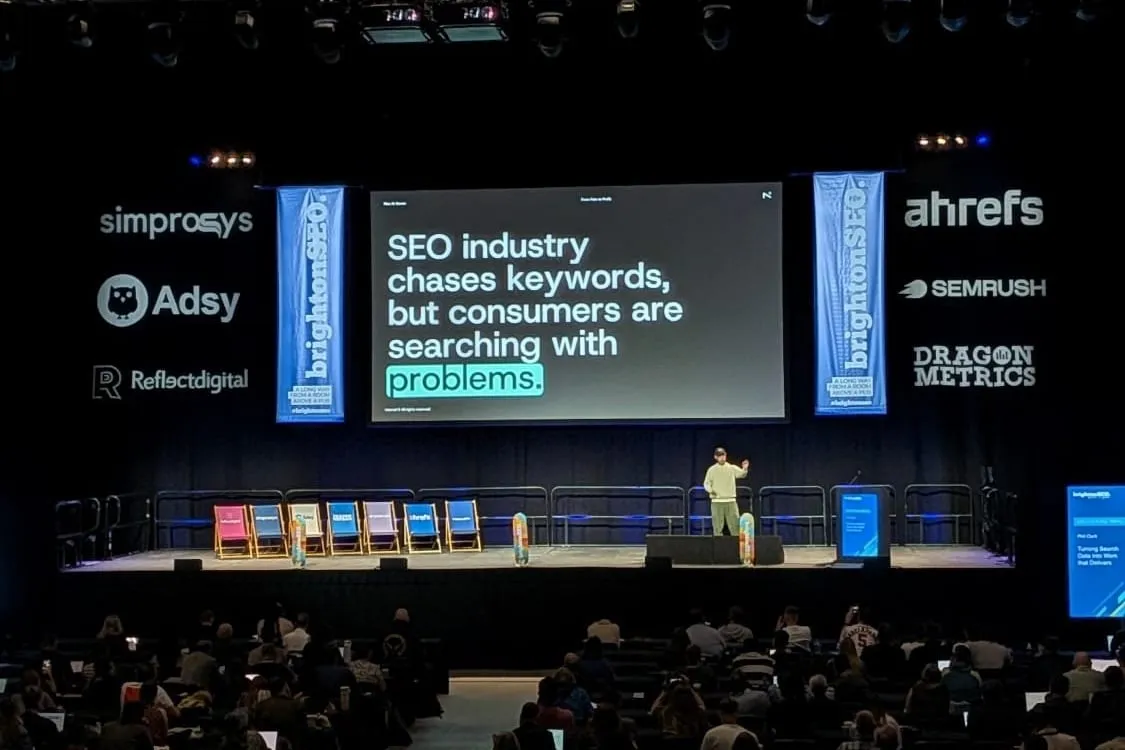
Nobody really knows how AI search works yet
The most refreshing thing about the conference was the speakers who admitted this openly.
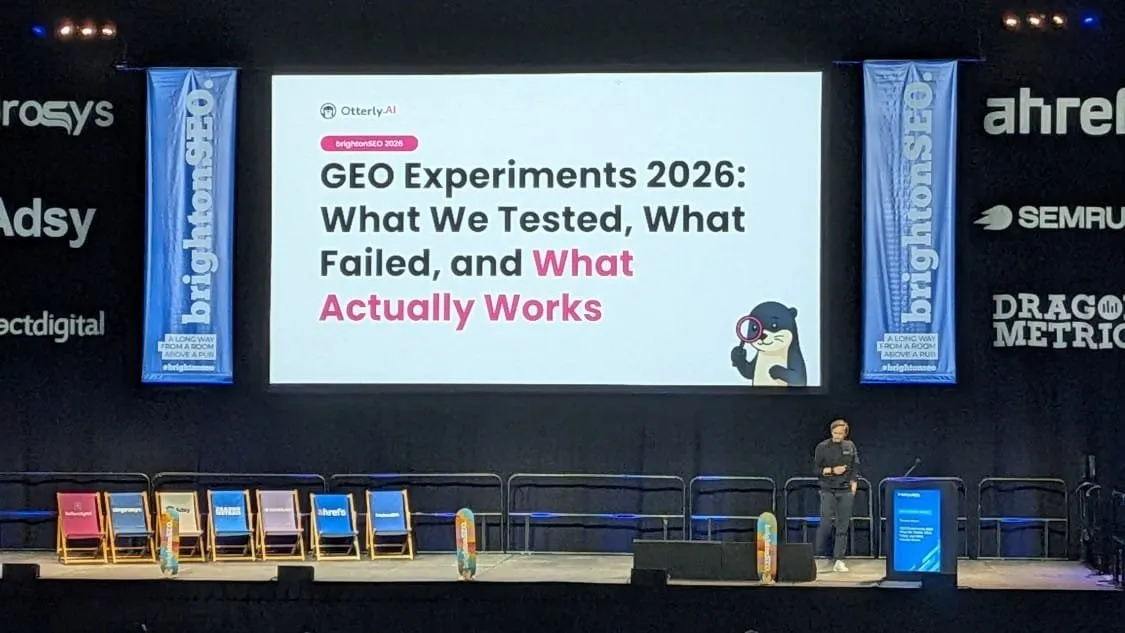
Thomas Peham from Otterly AI ran through 12 months of GEO experiments. Some findings were properly counterintuitive. Their llms.txt file, the one LinkedIn insists you must have, gets 0.1% of their AI bot traffic and performs three times worse than the average page on their site. Schema markup helped Google AI Overviews but had no measurable effect on ChatGPT, Claude, Copilot or Gemini. Markdown pages received 0% of AI crawler traffic when HTML versions of the same content sat alongside them.
Janaina Barreto-Romero from Oncrawl used a poker analogy: nobody at the table has a royal flush, and a lot of the people claiming to are bluffing. The cards she is actually playing with are revenue alignment (clicks are down but revenue often is not), technical debt as a visibility risk, brand presence, and log file analysis as a proxy for AI visibility.
Ryan Law from Ahrefs gave the most useful technical explainer I saw. The mechanics matter. ChatGPT primarily uses Bing’s index, Claude uses Brave, Gemini uses Google. Ranking well in traditional search remains a strong predictor of being retrieved by AI search. The plumbing is still SEO.
The AI citation tracking problem nobody wants to talk about
Every major SEO software company is now selling some flavour of LLM visibility tracking. Several speakers, politely, pointed out that this is mostly marketing.
Cosmin Negrescu from SEOmonitor was the clearest. There is no reliable demand data for prompts. Estimating prompt volume via clickstream or AI estimation is unauditable and inconsistent. Different LLMs personalise responses heavily, so a single tracked prompt is not a single deterministic answer. Tamara Novitović added that some AI dashboards are essentially humans manually checking prompts at random intervals, dressed up as automation.
The honest conclusion is that LLM citation tracking is not solved. The tools are early, the data is noisy, and anyone selling a confident dashboard is selling certainty that does not yet exist. You can measure trends and directional movement. Treating it like Google rankings circa 2018 is a category error.
The shiny new toys: automation and prompt libraries
A whole track on Friday was dedicated to SEO automation, and it is clearly where a lot of consultants are spending their evenings. Gus Pelogia walked through MCP servers with Claude Code for keyword work and SERP scraping. Nicolas Montanares showed an n8n workflow running 80 technical SEO checks against any URL. Jonathon Roberts demonstrated a full Node.js auditing app, again largely vibe-coded. Tom Winter from SEOwind pushed back on the “AI is rubbish” mindset, arguing that the real problem is that most teams have aspirational content processes they never actually follow, and AI’s advantage is doing the same 50 verification steps consistently every time.
Emma Moletto’s prompt library framework was the cleanest practical takeaway of the conference for me. Her SCRIPT structure (Situation, Character, Request, Instructions, Proof, Template) gives you a consistent way to turn one-off prompts into reusable assets.
The honest read: there is genuine value here, alongside a lot of consultants playing with new toys hoping for a revenue lift. A faster way to do something pointless is still pointless.
The fundamentals have not changed, and that is the actual story
This is where I want to push back on something creeping into agency positioning lately: the framing of AEO as a separate, parallel service to SEO, with its own deliverables and its own line on the invoice.
Several speakers, from very different angles, made the same point. Tamara Novitović was direct: “AEO is a separate discipline” is a myth, easily disproved by reading any GEO playbook and noticing it is recycled SEO principles with new vocabulary. Haider Ali from Roast argued that strong technical SEO, content and digital PR foundations drive GEO results, and that adding GEO tactics on top of weak foundations is wasted effort. Janaina’s data on technical fundamentals such as crawlability, indexability and page speed still mattering for LLM citation aligns with this. Ryan Law’s mechanics confirm it. If the LLMs pull from Google, Bing and Brave’s indexes, then ranking in those indexes is still the primary lever.
The genuinely new things matter at the margin. Brand mention frequency was the strongest single signal Ahrefs found for AI Overview visibility. Comprehensive content addressing sub-queries, the fan-out problem, matters more than ever. List-format articles outperform other formats for AI citation in some categories. Veronika Ulla Höller’s talk on shadow data was a useful reminder that old PDFs and retired pages can sit in LLM training data for years, distorting how a brand is described. These are refinements to a strategy rather than a replacement for one.
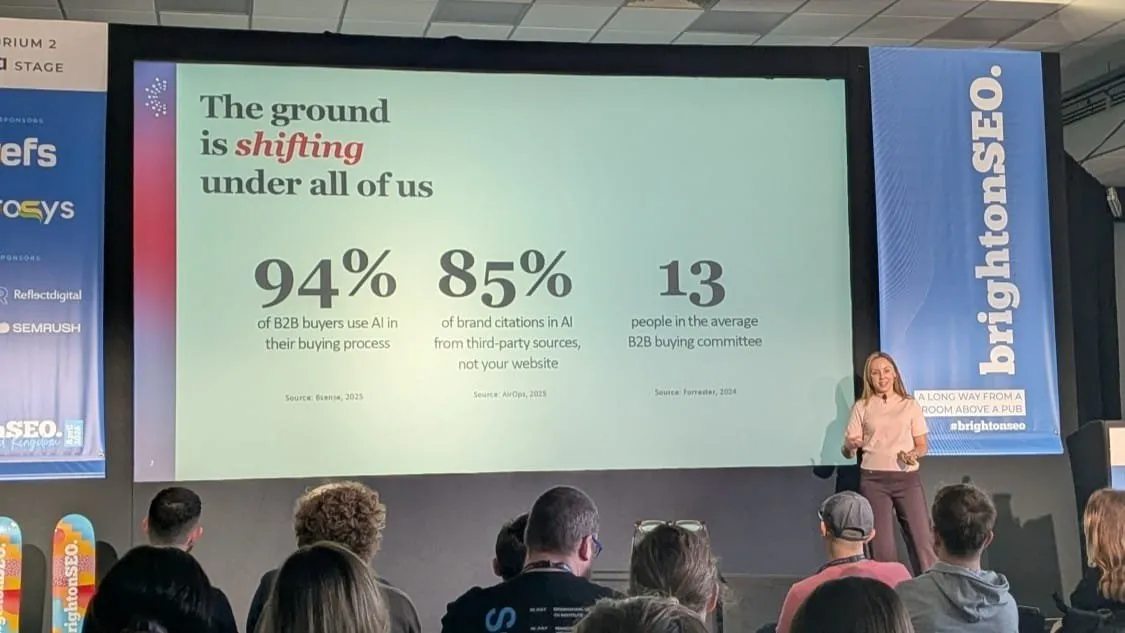
The blunt version: if your SEO foundations are weak, no amount of AEO will save you. If they are strong, the AI search work is largely the icing. I have written more on what that means for a local business in SEO for Eastbourne businesses.
This feels a lot like 2010 SEO
I did not live through the wild west of early SEO, but I have heard enough stories. The pattern is familiar: a poorly understood new channel, a flood of self-appointed experts, vendor tools claiming to measure things they cannot really measure. There is real value in the honest experimentation happening, alongside a lot of confident narrative built on very thin data.
The thing that gave early SEO a bad name was not experimentation. It was the people who built businesses on selling certainty they did not have. The same dynamic is forming around GEO and AEO services right now. Be wary of anyone who tells you they can guarantee LLM citations, or who has a proprietary methodology for AI ranking factors they cannot really explain. There are five questions worth asking any supplier in this piece on hiring a web designer or SEO.
What I am taking back to client work
Three things change in my workflow after Brighton. First, I am doubling down on fundamentals: crawlability, page speed and structured content, brand mentions, digital PR. These move the needle for both Google and AI search, and they are what I can actually defend with data. Second, I am tracking AI search directionally rather than precisely, with manual prompt checks across two or three LLMs on a regular schedule, looking for trends rather than chasing absolute rankings. Third, Emma Moletto’s SCRIPT framework is going into my workflow this month for any task I do more than twice.
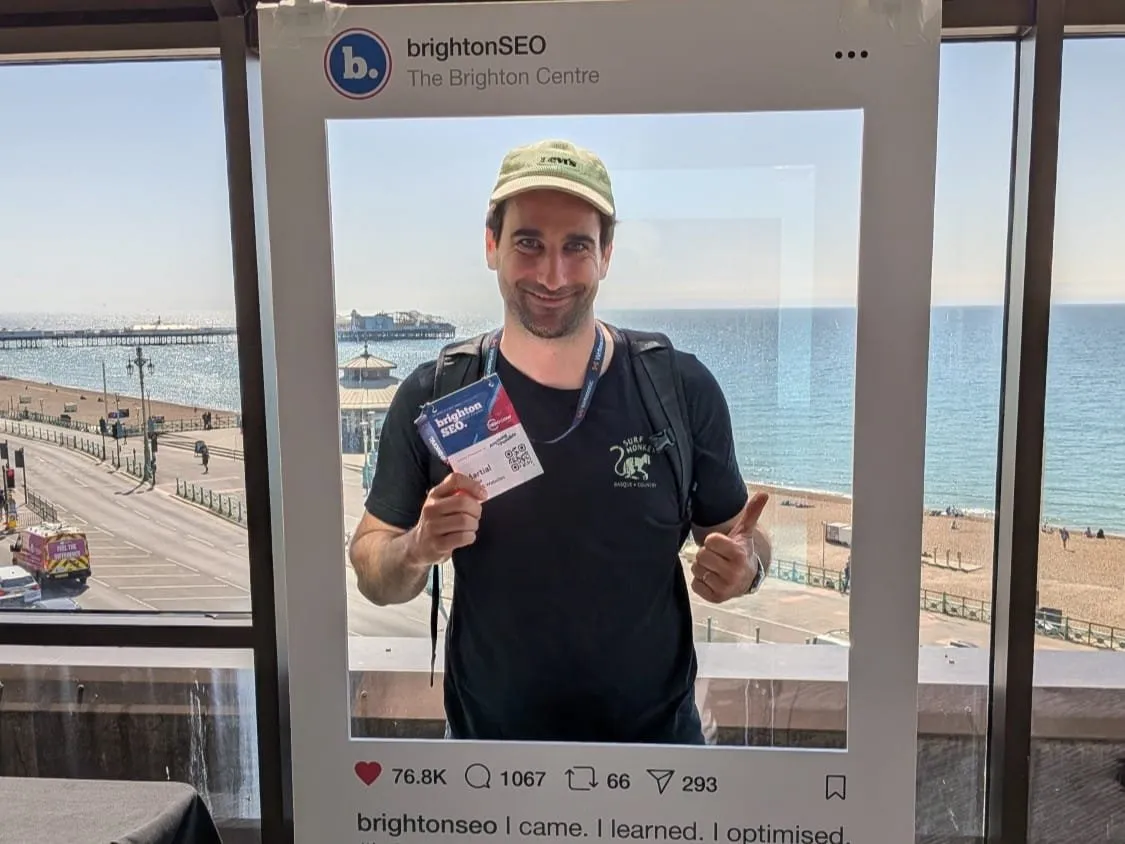
The biggest lesson was the one I came looking for. Most of the people selling AI search certainty do not have it. The ones doing the most interesting work are running real experiments, sharing what failed, and admitting what they do not yet know. That is the company I want to be in.
If you are rethinking your SEO strategy in light of AI search, get in touch or see how I work with clients.